Rock sitting at sunset, I acknowledge the lost art of stillness.
How, over time, a human can blend into some wild scene unnoticed, stoic as the stone she is crouched upon, so that life goes on around her, undisturbed.
A person no longer a threat. A presence no longer an intrusion.
How the slowing of a body has become equally as difficult as the slowing of a mind, in this fast paced society we’ve built for ourselves. Where 24 hours in a day is simply not enough, 40 hours no longer pays the bills, and an empty calendar day equates to idle negligence.
The degree of effort it takes to just sit there, somewhere, anywhere, and just be.
Without a mind wandering, a screen scrolling, a message typing, legs pumping, motor running.
This subconscious pull, seemingly gravitational, towards a distraction, a destination, a dependence.
Gutted but goal-oriented, we move. Forwards. Backwards. Side to side. But never still. Never still.
Quietude is an outlandish alien in America. Debunked and deemed a hoax, picked apart by the nonbelievers, the peddle pushers of progress, perseverance, effort and exertion, as if struggle is the only thing left for us to believe in.
Crushed is the shell of a turtle too slow to keep pace in this modern world. Lost is the wisdom she carries within her gaze. Ancient eyes from the time of dinosaurs, tires treading on territory now paved over and potholed, too fast for her and her kin, so fast it might kill her kind entirely, in a century or less, when turtles, as a species, have survived millennia.
Parties and purpose. Lists and ladders. Influencers and idols. Momentum and marketing. On brand and on point.
Quickly now.
Or they will pass your ass, over and across the double lines, because 10 miles over the speed limit isn’t fast enough.
Get left behind.
Or worse, get flattened beneath, some jacked up low tread tire racing down a country road, Formula 1 in a 35.
Still… is how I found myself surrounded by beavers. Slow… is how I entered the lake, wading through the thigh deep water, careful of the steps I couldn’t see but had to feel, bare feet in the muck, lucky to have spotted the rock from a distance, this perfect offshore sit spot, solitary, secluded, at sunset. Luckier still to not have noticed, it emerged from the depths right next to a lodge.
As the sun went down, the beavers returned home. Floating and feeding as a family. Gliding through the water, freely in, out, and about, their heads bobbing above the surface, getting lost amongst the lily pads, only to disappear below, just to pop up again in another place, to my left, to my right, drifting, diving, fluid, flowing, streamlined, synchronous, as I watched in wonder.
I could have turned forty anywhere I wanted, the start of a new decade a bigger deal than any of the in-between years. Maybe not as big as 13, as 16, as 18, as 21, but a milestone just the same.
I chose to celebrate quietly, in the company of beavers, stoic as the stone I sat upon, at sunset, watching the wild, as I disappeared into the background, unnoticed.
Here, I am not the one to pay attention to. Centerstage is reserved for the natural world. It grandstands just by existing. I am captivated by default. A gracious guest on borrowed time, witnessing the beauty of an untamed place, wishing I could just sit here, today, tomorrow, forever, practicing the lost art of stillness.
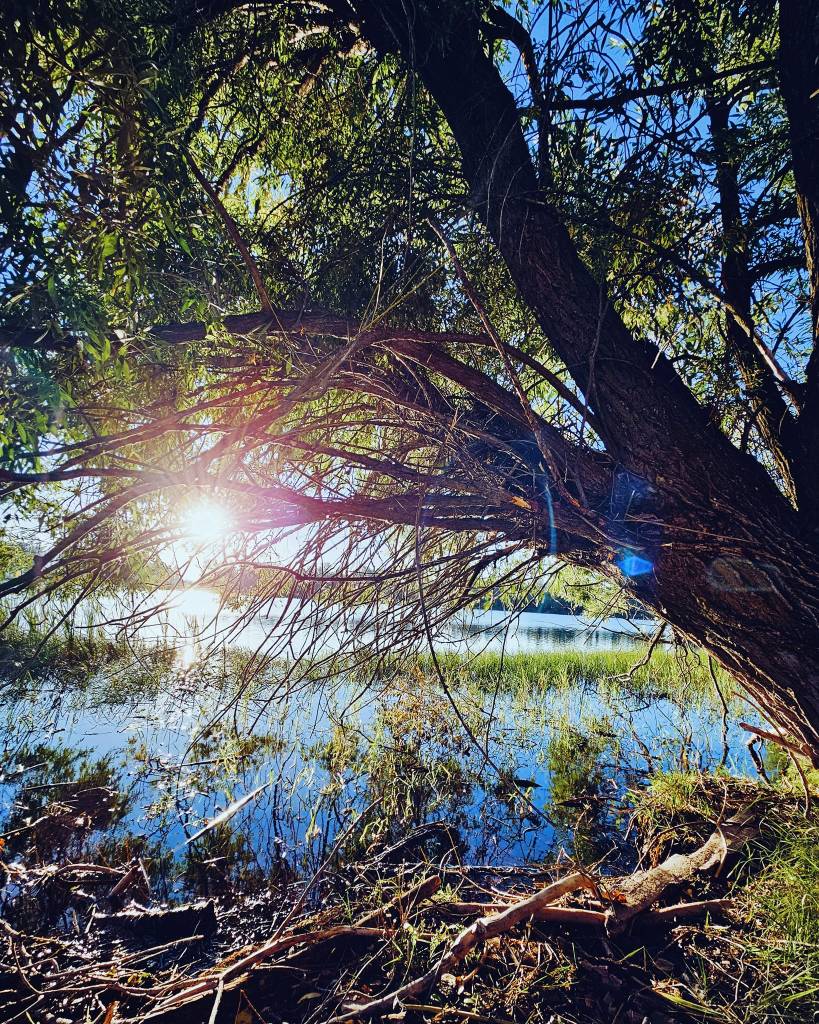
Upon returning to Montana, I settled into the wild rhythm so easily – rising with the sun as it emerged from behind the mountains across the Flathead River, spilling both its light and its warmth into my blue and orange Marmot – nestled beneath a sprawling Willow tree. Crawling out from the coziness of my sleep sack, I shed my thick wool socks and thermal sleep clothes, grab a towel, and make my way to the water’s edge.
It’s the perfect entrance, almost as if it were by invitation, this place where the aquatic grasses thin, creating a single person width path from the shoreline out to the deeper water. “Enter here,” the space beckons.The Willow extends her limbs up and out, over and across, providing coverage and camouflage, a place less exposed for my daily plunge.
I remove my shirt and let the crisp morning air dance across my bare skin. My foot hovers inches above the water in expectation of the cool sensation about to meet it.
My feet sink into the sediment and disappear beneath the mud, creating pastel swirls of khaki colored mud with each step. Blades of grass glide past my hips and slip between my toes. My body adjusts to the shock of the 50 some degree water with a sharp inhale and a series of shivers. Who needs coffee when you can start the day like this? The cool water jolting you to be present in the moment, to be present in your body – taking it in with all of your senses.
An Osprey dips low, flying just overhead. I lift my hand in greeting and call good morning as it passes by – indifferent to my nakedness. The Sandhill Cranes call out behind me, their bodies obscured among the cattails and tall wetland foliage. Their presence is known only by the hauntingly beautiful sound of their voices. I wade out until I am chest deep, taking in full, deep breaths of morning air. I cup the water in my hands and let the cool, fresh water cleanse my face. I take a dip, do a quick wash of my body and then I make my way back to air dry beneath the trees – basking in the warmth of the morning sun, letting its rays kiss away the cool droplets that remain.
These slow mornings are something to cherish. Nowhere to be but right where I am. The only time constraint is making it to the Goat Cafe in time – ensuring that I get fresh milk squeezed right into my morning coffee. Add a dash of raw honey or maple syrup and boom – perfection in a cup.
To wake beneath a Willow, knowing your hands will soon grow tired and your thumbs will become calloused from weaving the limbs of one of her sister trees, provides this magical opportunity to connect with the spirit of a tree – who lends its flexible and resilient body to weavers – crafting beautiful and durable baskets of all kinds.
We narrow our possibilities for knowledge and wisdom when we limit it solely to learning from our human counterparts. There is so much that nature can teach as well as provide – in every facet of our lives. But it’s only when we begin to recognize and embrace the interconnectedness of all things, that we start to understand. We are far closer to the rhythms of nature than we are led to believe. But here we are, making our primary concern in life how to make ourselves more profitable. We commodify our other-than-human counterparts rather than seek their companionship and counsel. We get lost in the hustle, in the daily grind, in the chaos of jam-packed schedules. We have lost what the slow and simple can bring to our lives. But here beneath the Willow tree, that is all there is.
In this tucked away place, I feel like the only person around. Maybe I am. I haven’t seen a soul all morning. I look up as the wind makes the tree tops dance and sway. They creak as their branches rub together in response. The fallen pine needles conceal the sound of my footsteps, but not entirely, as I catch sudden movement to my left. A Red Squirrel dashes across the forest floor, scurrying up the nearest trunk to get a better view of the outsider. But his/her alarm system remains silent. No threat here. “Hello there little one,” I whisper as I continue my search for a sit spot.
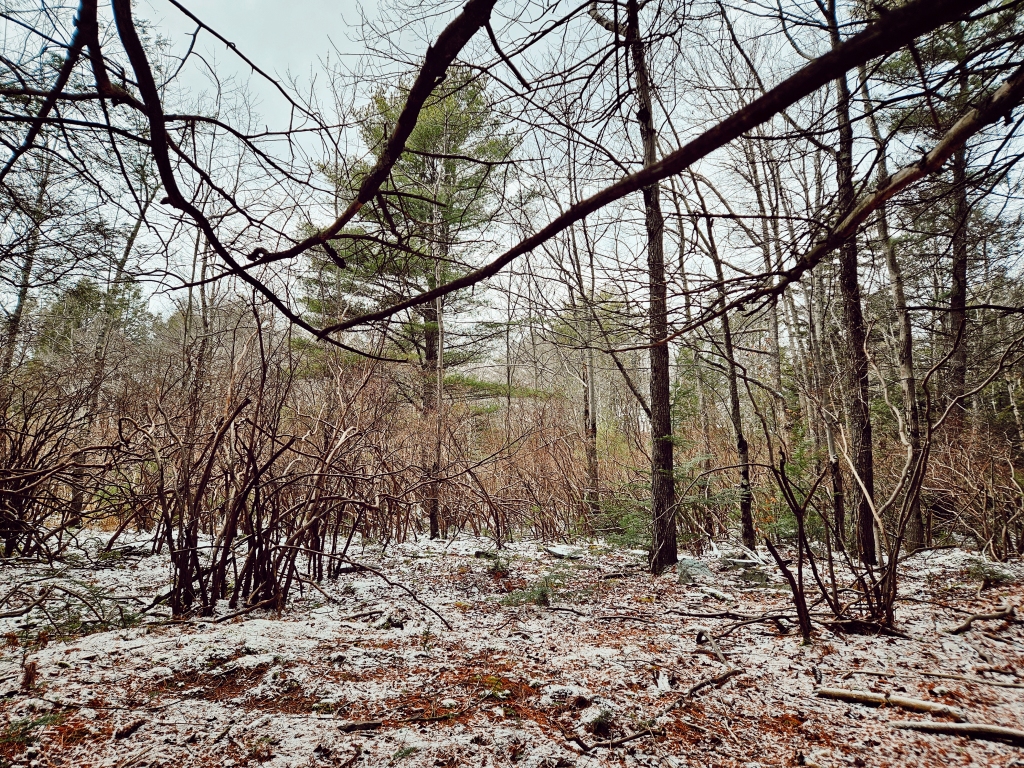
The quality time I’ve been waiting for has finally arrived. My chance to wander the winter wood and revisit a place we discovered last year. Barren branches twist and bend toward the sky like arthritic, skeletal hands, creating a tangled garden wall that closes off this small patch of forest from the rest, creating this perfect circle. I have to duck my way in to clear the entryway the deer have made into this isolated hideaway. It’s chilly, but I’m cherishing this morning of solitude and silence.
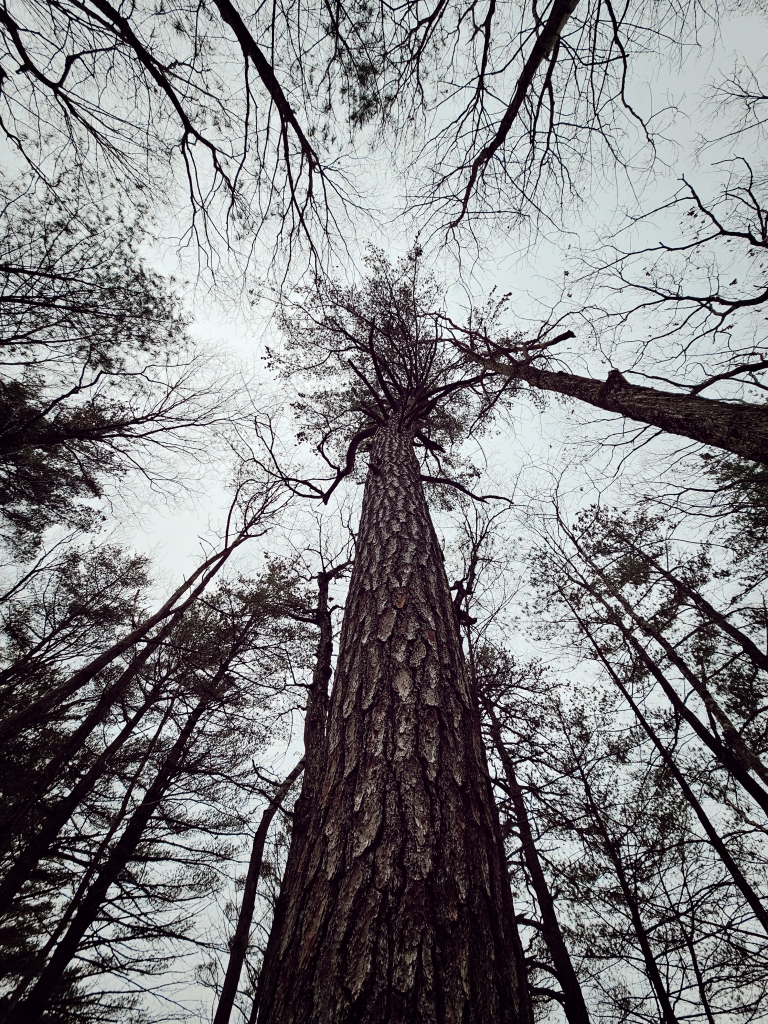
All I want for Christmas is already here. The thought flashes through my mind as my back nestles against the thick, chunky trunk of a pine. A group of geese fly low overhead, obscured by an overcast sky. Their honking disrupts the silence that surrounds me. Snow starts to fall ever so lightly. It tinks against the fallen leaves that still remain.
It seems so simple – the wish for a walk in the woods, the feel of a winter wind on exposed cheeks, the crisp, clean air filling my lungs, the familiar scent of pine diffused beneath a canopy of trees. The desire to be uninterrupted.
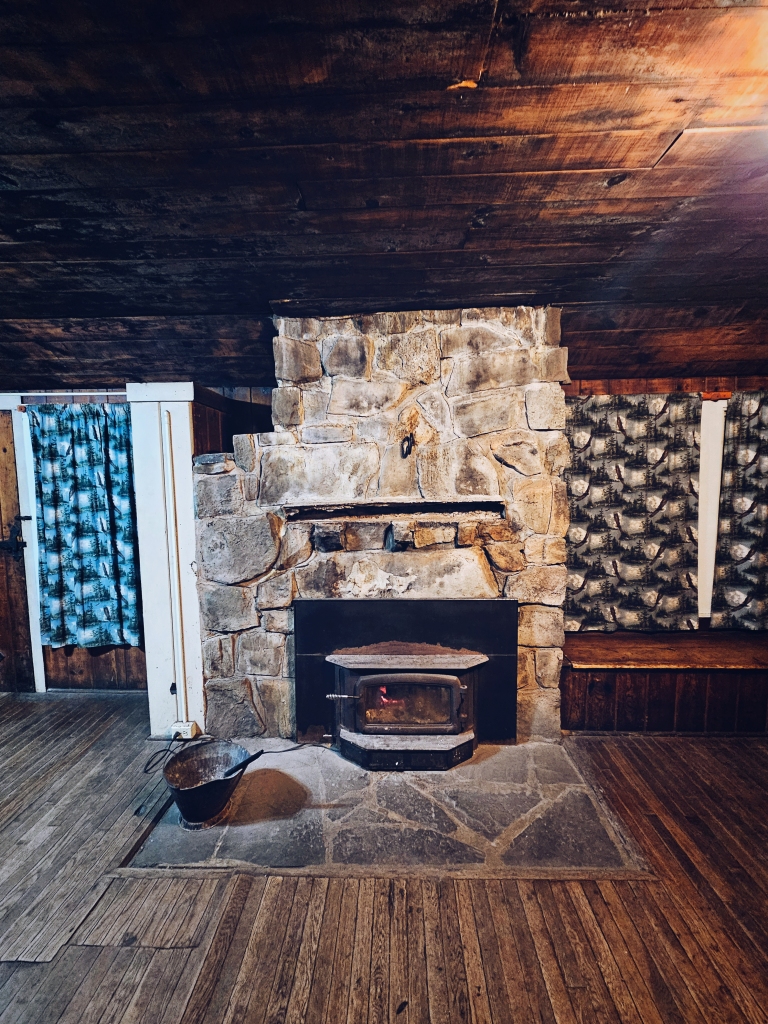
Just a few days where life is reduced to a rustic cabin, feeding a wood stove, eating hearty chili on repeat, and a worn, wooden table to spend time at – talking, reading, writing. No computers, no phones, no television screens. And each day, I am free to wander. No concern for clocks, decisions, or deadlines – just following the sun from dawn to dusk.
This winter cabin stay has become an annual tradition of ours – born from my love of a particular place and the need for a seasonal reprieve from the hustle and bustle of the holidays. We long for some quality time together disconnected from the screens we’re stuck to all year long, all week long – laptops for work, phones for scrolling, and TV to occupy our overworked and exhausted minds.
My Christmas list begins and ends with this.
There’s an automatic feeling I get that starts in November. Everything becomes “too much” – no matter the year, no matter what I do, no matter how much I don’t do. It’s smothering to me, the intensity of what the holidays have become in our society of insatiable consumption. There’s this general sense of anxiety, overwhelm, and irritation – even when I hermit away. If my work-life balance is off-kilter, it only compounds these feelings.
The last few years, we’ve been working to break away from the chaos and madness that has become the standard holiday procedure. Though, deprogramming from the not-so-merry matrix was harder than we thought. We had no idea how enmeshed we were until we began to untangle ourselves from it. What we thought would be something immediate, was, in fact, not. For those around us, it seemed like a “war on Christmas” with Scrooge-like tactics – opting out of what we should be doing, what we’re supposed to be doing, what everyone does and in what measure. It was met with confusion, resistance, guilt, shame, and backlash.
Was it possible to opt out? To keep what replenishes us and abandon what causes physical, emotional, and financial stress? What parts are commercially driven? What parts are driven by joy? Can we stray from the norm? The shopping, decorating, cooking, cleaning, commuting, waiting in traffic and long lines, maxing out credit cards, losing your shit with incorrigible family members, forcing smiles, and attempting to be present while hiding the fact that we’re all exhausted, overwhelmed, anxious, irritable, stressed and strapped – for time and for money. We spread ourselves so impossibly thin trying to do everything all at once. And after all the gifts, there’s not much left to give. There is no break, no slow down, no rest. Everything in excess.
It is only now, after our initial conversation years ago, that we’re moving ever closer to the simplification we seek. Voluntary simplicity in our complex, consumeristic world is a process. It requires more than just flipping a switch from that to this. It’s more gradual than immediate. A shift versus an abrupt halt. And the time we spend at the cabin is both affirming and reassuring that our desire to choose a simpler, more intentional life is what is right for us. However slow, we’re moving in the right direction.
What I experience this time of year is not just a result of our desire to simplify. For me, as a child, the holidays stopped being merry and bright at a young age. My mother’s addiction, coupled with her toxic and increasingly abusive behavior tore open a void so vast and so infinite, that it swallowed our entire family and any memories we had of happier times together into its blackened oblivion – as if it had never existed at all. The only thing my sister and I were gifted from her thereafter, was the blunt-force truth of how motherhood, for her, was a major mistake. A tree was still decorated each year, but no longer with us. Presents towered on the loveseat next to it, but none of them were ours. Beneath it, was purposely left empty. I wonder if she believed taking away our gifts was what would hurt us the most. But the thing was, presents were never a priority for me. I was a child who rarely asked or wanted for much.
And because of that, my wishlists were always short. My favorite gift was nothing extravagant – it was a stuffed Pongo from 101 Dalmations. I named him Shadow, after the Golden Retriever from Homeward Bound: The Incredible Journey. A movie I must have watched over a 100 times, maybe more. I took him everywhere with me – until his fur matted and turned gray, until his plastic eyes rubbed away, until he was falling apart. The two of us had some pretty incredible journeys ourselves. Shadow, coupled with an innate gift of a wild imagination was magic to this quiet, solitary child. I could be entertained for hours with just one stuffed friend and the forest as my playground.
I was simple in my nature from the very beginning. But as I grew up, that simplicity was made to seem like a defect, something to correct rather than to embrace. It was abnormal to be content with less. To want very little. It was strange not to care much for the things that everyone else did. That wild imagination of mine lended a helping hand in getting really good at pretending I was like everyone else. Until, eventually, I was. It’s only now, over the last few years, that I have been re-discovering my authentic self – my identity, lifestyle, values and beliefs – and reconnecting with the person, mindset, and way of life that makes me truly happy.
In my mother’s efforts to abolish our holiday happiness, it wasn’t the presents I missed. It was listening to Christmas records on repeat, singing and dancing around the living room. It was the way the tree lights lit up our faces in all their blinking glory. The special ornaments that we hung. Taking long drives in the country pick out our favorite Christmas decorations. Putting out the cookies and milk for Santa and making sure there were carrots for each of the reindeer. Sitting up in bed with my sister and listening for the hoof stomps on the roof, swearing that we heard them. The excitement of waking up on Christmas morning and anxiously waiting at the top of the stairs, trying to peep through the wooden railings without getting caught. The time we spent together on Christmas morning, gathered under the tree – talking, laughing, and playing around the piles of wrapping paper before we headed to Gram and Pa’s house.
What I missed the most was the memory of my mom back when she still wanted to be a mother. I missed how happy my dad looked when we were all still together. I missed laughing with my sister when we were still best friends. I missed my mother’s hugs. I missed hearing “I love you”. I missed all the things we so often take for granted – unknowingly as children, unconsciously as adults. I tried to hold onto what Christmas was like in the “before” time. I relived it each year in the “after” because I thought if I didn’t, I might lose it forever and I didn’t want to let it go. This meant spending a lot of Christmases that were quite the opposite of comfort and joy. For years, I was buried beneath chaotic emotions of sadness and anger mixed with nostalgia for a lost time. I didn’t address any of this until much later in life. But in my nonlinear, unconventional, and still very much ongoing journey, I came to realize something.
No longer experiencing the typical childhood Christmas, I was able to grasp its true meaning, or at least what it had meant to me, very early on. Of all the things I went without, of all the things I wished for every year thereafter, presents were never one of them. I would have taken every gift I ever got and given it all back (well, maybe except for Shadow), if it meant I could be happy again, feel safe again, feel wanted and loved in my own home. If it meant I could get back all the laughing, smiling, singing, joking, dancing, and having fun. I wanted long car rides to nowhere, snow forts in the backyard, and capturing our special moments on home video. I wanted the peaceful nights that got replaced with drunken harassment. I wanted all the little things that when pieced together, punched a massive hole straight through my heart. None of the things I wanted most had come from a store. I wasn’t old enough to comprehend what that all really meant, even if I had unknowingly realized it back then.
What are the most meaningful things in my life?
What do I truly value?
What can I live without?
What don’t I want to live without?
What brings me joy and happiness?
What am I missing out on if I am not present, if I am not paying attention, if I am stressed and overwhelmed?
How conditioned had I become by life circumstances, by those around me, by society, by failing to address my own healing and wellbeing?
How far did I stray from who I am? What I once believed?
What do I know, deep down, to be the greatest gift of all?
What did little Steph want most back then?
What does big Steph want most right now?
*******
At 38, I’m seeking comfort and joy.
I’m creating those silent, holy nights.
I’m walking in a winter wonderland.
I’m putting more than a little love in my heart.
I’m bringing back all of my favorite things.
More and more, it’s beginning to look a lot like Christmas around here. And yes, it’s one that “comes without ribbons, without tags, without packages, boxes or bags.”
There is magic to be found in these shorter, darker days. And it’s much simpler than what is being sold to us. This magic returns when we begin to rediscover the true meaning and spirit of the season. What winter represents and what happens when we allow ourselves a slow down – a time for reflection and restoration. In our hibernation, we go inward, perhaps spending more time on all that we let slip away during the preparations of spring, the life-giving months of summer, and the abundant harvests of fall. The winddown should be now. And yet, no matter the season, we have found every which way to complicate and overwhelm our lives – even more so during the holidays. We overlook all the beautiful, wonderful things of our everyday lives. We stop taking the time to appreciate these moments and experiences and to express our gratitude, even for the simple fact that we are alive – right here, right now.
The warmth of a fire.
The cozy comfort of a favorite sweater.
The healing powers of a medicinal tea.
The comfort of a handmade blanket.
The silence of a heavy snowfall.
The stillness of a forest in its dormancy.
The quietude of time tucked away.
The transformative power of inner work.
The laughter of a loved one.
The fullness of our hearts instead of our closets.
Can we stop and ask ourselves, what more do I need?
We have become a society that is too busy, too distracted, too stressed, too overwhelmed, too angry, too anxious, too frantic, too overworked, and far too demanding to appreciate all the little things that make up a really big thing. We have forgotten the greatest gifts that all of us do not have in equal measure: LOVE and TIME. Love – how are we showing it? Time – how are we spending it?
Little Steph and Big Steph aren’t so different from one another. Little didn’t want much even when there was a time she could have asked for anything. Big doesn’t want much either, even in a time where she can ask for anything – right now, present day.
My Christmas list is as short as it ever was, comprised of all the little things that make up everything to me:
Love
Time
Peace
Safety
Laughter
Rest
Conversation
Gratitude
In Cabin 12, there used to be four names carved into the wall to the left of the fireplace. It was back in the early 90’s, so those carvings are most likely long gone by now. I can’t remember what they all decided on – their initials, first names, or something made up. I only remember the mother’s. She decided to carve “Ziggy Stardust” explaining to her family how the nickname given to her by her friends was the same name as David Bowie’s alter ego.
“Ziggy played for time
Jiving us that we were voodoo
The kids were just crass
He was the nazz
With God-given ass
He took it all too far
But boy, could he play guitar
Making love with his ego
Ziggy sucked up into his mind, ah
Like a leper messiah
When the kids had killed the man
I had to break up the band”
There is a picture kept – one that captures this moment, frozen in time, so that a memory can take shape outside the mind of a little girl. The father is carving away with his two daughters, one in the matching oversized sweatshirt they both loved so much. The mother is behind the camera.
Oh, the rise and fall of Ziggy Stardust.
But none of them knew it back then.
Some of my greatest childhood memories were spent in these woods, in these cabins. This is a gift, coming back here to this special place to make new memories of my own with the person that I love. And so here I am, sitting at a table, so simple in its design it looks crudely made by today’s standards. Yet it’s still here, decades later, each cabin having its own. It’s so old now that the tabletop feels more like glass than wood, smooth and weathered from time and use. Four simple chairs were built to go with it. My husband sits across from me. We’re laughing, really hard, at something stupid he just said. His laugh is the fucking best thing in this world. I snapshot this moment in my mind. His smile, that laugh, the way he’s looking at me. How my hands disappear as he scoops them up in his. His dirty bare feet stretched out towards the fire.
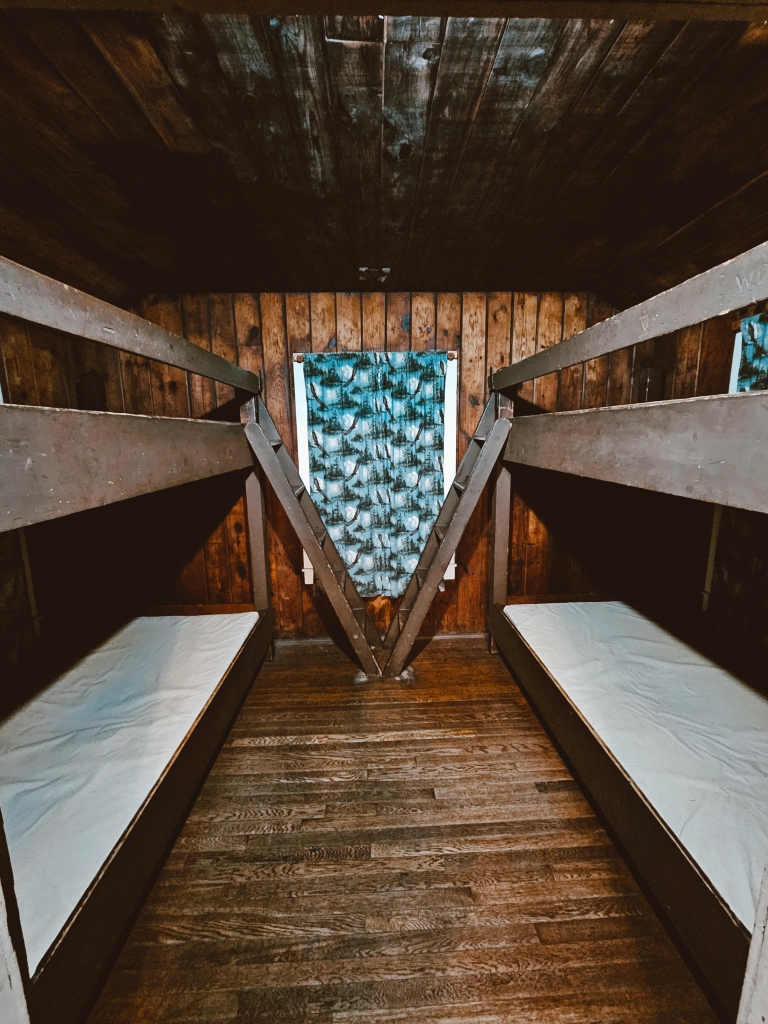
We’re both wearing old long johns. I’m in my favorite wool sweater while he’s in a fleece-lined button down covered in fabric pills. My ratty pair of slippers probably should have been tossed out by now but they’re here on my feet. Our wool socks hang from the back of the chairs drying from today’s wear. The cabins aren’t insulated. Blustery drafts seep in from every angle and corner so we keep the wood stove stacked. There is no TV. No computer. No service inside for our phones. The only other room has two sets of single bunk beds, each with their own thin, hard mattress to sleep on. We bunk across from one another, carrying the table conversation to our beds. Each night, we leave a cracker out for the resident mouse who visits through the uneven space between the wood panels of the ceiling and the stone of the chimney.
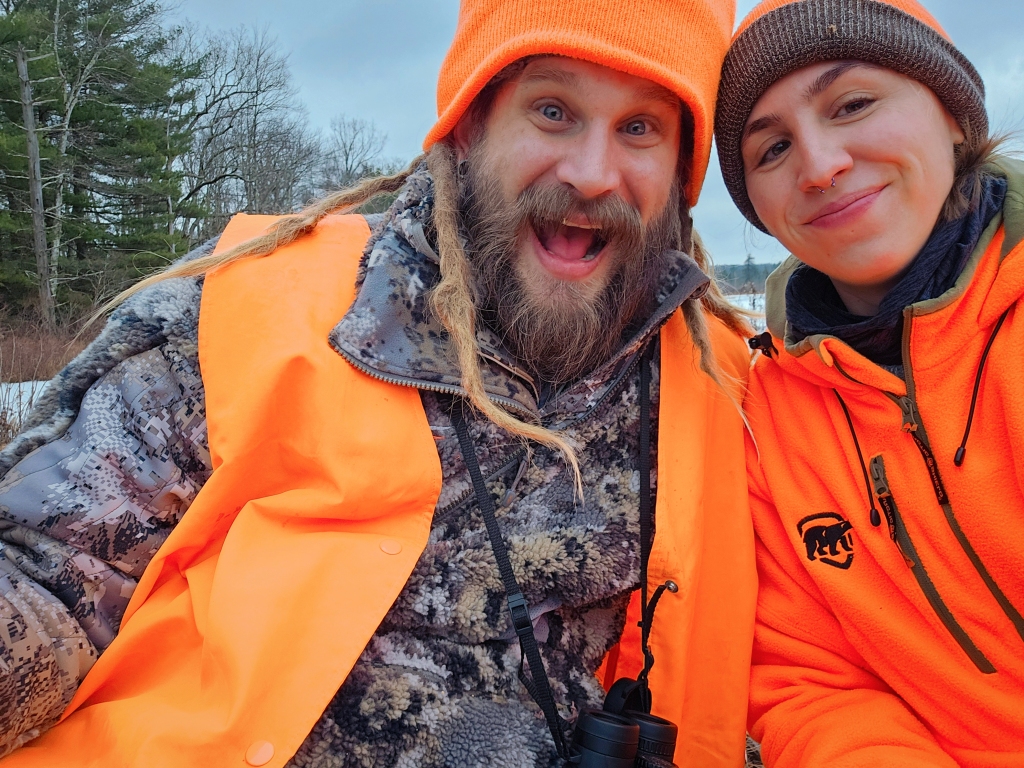
Bear wakes early, reloads the stove with wood, and puts on a pot of coffee. He hunts at daybreak while I wake up slowly, uneager to abandon the warmth of my sleeping bag. I scramble back into my long johns, take the cold walk to the bathroom, and warm up again by the fire with a book in hand. Eventually, I bundle up and go wander out in the woods – sitting in one of my favorite spots, tucked away from the trails. Each night, we return to the table for two bowls of chili and more conversation, dreaming and scheming up our life plans.
When we talk about history, our stories tend to drift to a person, a place, or event – almost always in relation to human activity. We trace our steps back through time to relive the moments and experiences of who and what came before us. We discuss art and architecture. Advances in civilization. Major discoveries and inventions. What human hands have built and what human hands have destroyed. We, as humans, seem to have this insatiable desire for development and progress. Our war machine constantly churns. So much of what once was could never withstand the test of time – not with our endless need for consumption and our compulsion toward destruction. A great many things have been lost as a result. Cut down and cut short by ballot, bullet, bomb, or bulldozer.
Just like people, places have memories. Their stories, their trauma, their growth and their decline are all experienced – as we experience our own. Just as the body keeps the score, so too does the land. It holds onto its history. There is energy and its expression – something that can be felt as well as seen. We bear witness to art and architecture. To creation and destruction. To invention and evolution. And none is the result of human hands. Because these things are not man made. It is the work of mother nature and mother nature alone.
But we don’t often visit a wild place to experience it beyond what we see before our eyes in the present day. If we want a history lesson, we go to a museum. Most likely, we’re out in nature for the trees, never questioning their age or existence. Or perhaps we are there for a scenic view or some destination water feature. Who doesn’t love a waterfall? There are various trails to trek or a summit to ascend. Could be pretty… or could be pretty unremarkable – that is, if we even bother to pay attention to where we are. How the majority of us experience the natural world today is a discussion in and of itself. To be IN nature, WITH nature, SURROUNDED by nature, and still somehow folks remain so disconnected from it. It is a byproduct of our modern society – to maintain these dysfunctional, detached, and disengaged relationships – with each other, with our communities, and with our surroundings. That has to change. As we work to build more meaningful and authentic connections with ourselves and with one another, so too, must we build more meaningful and authentic connections with the land.
What did these mountains, hills, and boulders bear witness to? As humans picked clean the bones of a place? As their communities became barren wastelands? As their kin was cut from the root? As their soils eroded and wildfires burned? How long have they waited for their new neighbors to seed, take root, and rebuild what was lost?
What did this place feel like before? Were land spirits present and alive? What beings called it home? How many trees were felled? How much ground was paved over? How much wetland was dried up and filled in? What was misplaced? What might now be extinct or endangered? How young is the flora in comparison to the age of the land? How fortunate is a natural area to have escaped development in the name of progress?
A Natural Relic
By 1900, the forests of Pennsylvania were devastated – with our state having lost more than 60 percent of them. The flattened landscape left was prone to soil erosion and wildfires – nothing but smoke and stumps. In a state of 28.7 million acres that was once almost completely tree covered, only a few hundred acres of true old growth was spared. The rest fell victim to the great deforestation – an unregulated logging industry mining for building materials, ship masts, and for charcoal. Our regional hemlocks and oaks were felled and stripped of their bark for leather making in the tannery business. All of this happening all around it, and yet, this boreal relic from the land before time remained.
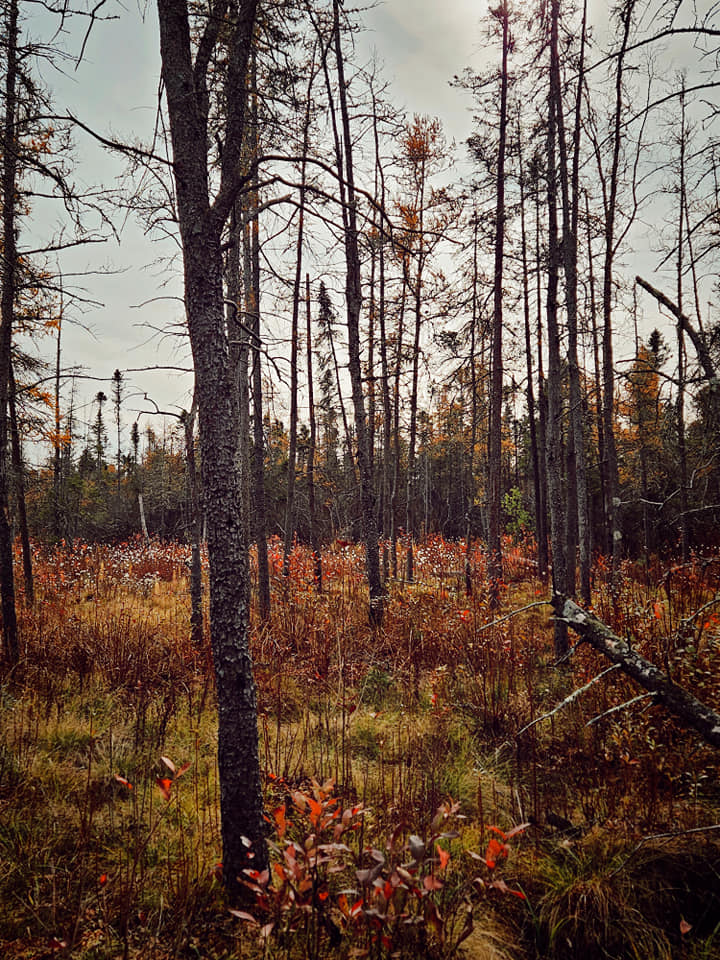
To someone unfamiliar, the Tannersville Cranberry Bog could be considered unremarkable – with its stunted trees, precarious “walking” conditions, lack of plant diversity (at least at first glance), less than scenic views, and required guided tours. But in reality, the bog is anything but unremarkable.
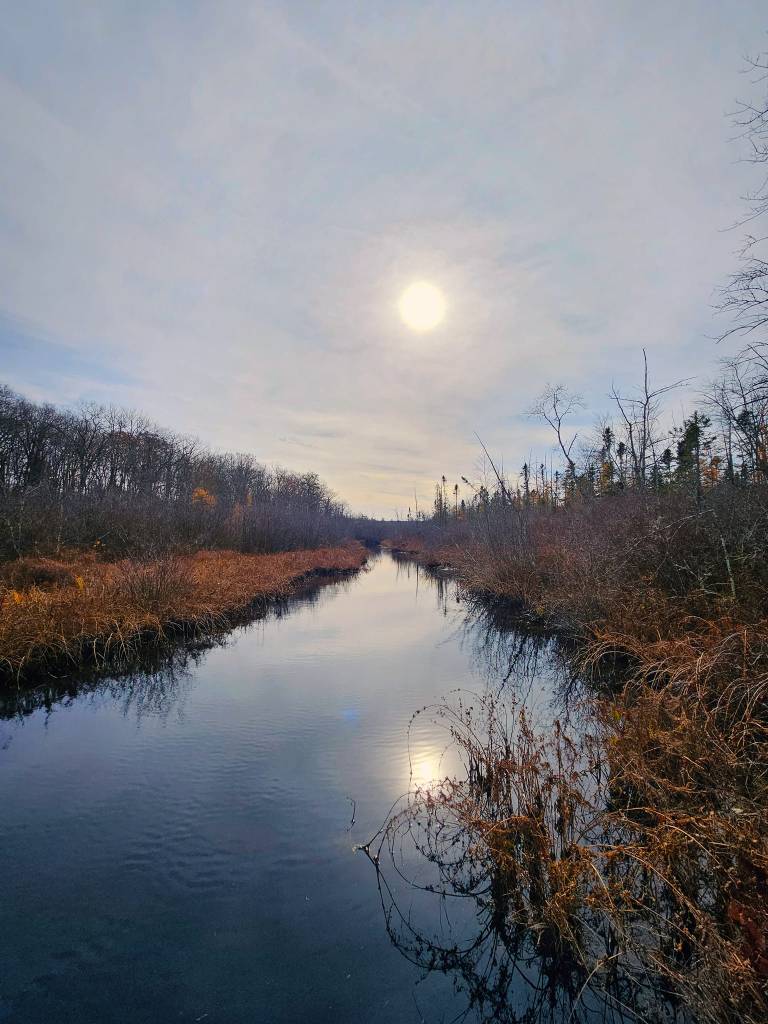
Thousands of years ago, a glacial lake once occupied this space that is now known as the Tannersville Cranberry Bog – a 1,000 acres of land protected under The Nature Conservancy. A bog like this is created over hundreds or thousands of years, formed when plant matter decays in a lake and begins to fill it. Peat deposits start building as the plants die and decay and the water turns acidic. The water is collected by precipitation and is held there by these layers through absorption. Bogs are freshwater, and in spite of the large amounts of decaying plant matter, they are very poor in nutrients. While the ice and lake have long receded, the bog remains – smack dab in the middle of the civilization that now surrounds it. This ecosystem represents an intricate transformation that took place over thousands of years – impossible to replace or replicate.
A considerable portion of the bog is covered with a boreal forest of black spruce and tamarack, two conifers normally found in Canada, at the southern limit of their range. It is the presence of these two Canadian conifers amidst an array of plant life unique to a boreal bog that makes the Tannersville Cranberry Bog such an incredible place to experience.
The beauty of the bog is hidden in its history, beneath its surface, in its ecological function, and the particular life it sustains within its unique ecosystem. The site was designated a National Natural Landmark in December 1974. The Cranberry Bog is nothing short of a natural treasure, a geological remnant of a long-ago ice age.
What’s a Bog?
A bog is one of several different types of wetlands that also include marshes, swamps, and fens. Each has their own distinct characteristics – defined by the flora and fauna they support. They are places which are neither land nor water. While other types of wetlands are very nutrient-rich, bogs are characterized by their lack of nutrients and relative inability to support large plant life. They have no drainage or inflow. No water gets in other than rain or snow and no water gets out except for evaporation. Bogs support plant and animal life that have adapted towards water-logged conditions, low nutrients, and acidic waters. The conditions of this unique habitat make them critically important to the species that live there.
The plant life you’ll find are high bush blueberry, leatherleaf, cranberry, sheep laurel, bog laurel, swamp azalea, and on the outskirts, rhododendron. Two others, bog rosemary and Labrador tea, are among the state’s rarer plants. Sedges and other plants typical of wetlands dominate the more nutrient-rich portions. There are two species of insectivores: the gorgeous, vibrant pitcher plant and alien-like sundew, which are found in the more open, sunny areas of the bog. Other beautiful and fascinating bog plants include grass-pink orchid, white-fringed orchid, rose pogonia, yellow lady slipper, and (formerly recorded but not seen in recent years) heart-leaf twayblade. There are also wild calla, cotton grass, poison sumac, the rare yellow-eyed grass and the rare dwarf mistletoe which grows as a parasite on the black spruce.
Bogs serve an incredibly important function – acting like a sponge – with vegetation and detritus breaking down incredibly slowly. Our sponge, the Cranberry, cleanses and controls pollution throughout the Pocono Creek watershed. Bogs aid in the proper cycling of nutrients and pollutants. They are carbon sinks, infinitely valuable in their ability to remove this greenhouse gas from the atmosphere due to their remarkably slow rate of decay. They are considered one of the most valuable ecosystems in the world.
A Land Before Time
Walking the bog is like stepping through a portal and transporting to a different time. Here I am, standing in a boreal ecosystem formed by glaciers thousands of years ago. I shut out the modern world and soak in something prehistoric – as if I were the peat moss itself. Everything is quiet and still. Civilization and man made sounds are obscured. The bog, both in aesthetics and function, is in essence, a giant sponge – densely packed with sphagnum moss, also known as peat moss. This sphagnum is super absorbent – plushy like a pillow. This, coupled with layers of dead vegetation beneath, create a bog’s foundation.
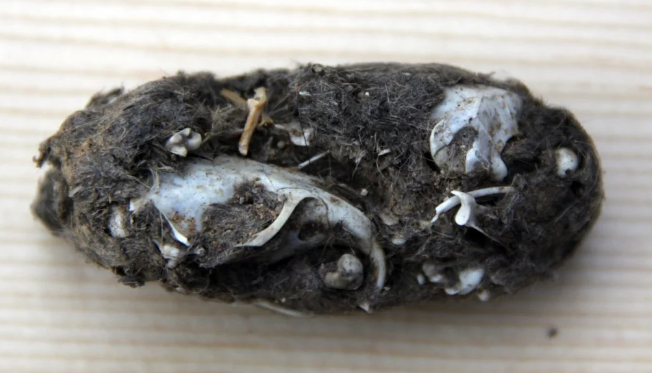
The bog is a tactile place. The textures are exquisite. Lichen of many species cover bark and branches. There are the sharp edges of a sedge grass blade. The delicate hairs of a carnivorous pitcher plant. The vibrant cranberry globes in stark contrast to the muted brown landscape of autumn. The plush blankets of moss with their brilliant hues which vary in color – emerald, lime, amber, crimson, and sepia tones. Even the otter scat, left atop the bog boardwalk, has remnants of undigested crayfish shells, flecking as the piles deteriorate.
There is a duality in this place – both fluid and solid, velvety and dense. There’s a richness to its water, steeped this vibrant and luxurious brown. It sits below, alongside, and within the spaces between hummocks, all at some indiscernible depth. These floating islands house the life above ground and are smattered across the surface of the bog. Depending where, to step off a hummock, might mean losing your boot – sinking a few inches, a foot, or several.
This bog emits an ancient energy – purposeful and radiant in its deliberate infiniteness. Here, you can see and experience life in slow motion. Here, time is both frozen and unbound. To wander the bog, is to let modern civilization slip away and in its stead, experience an extraordinary place of the past, one that would be irreplaceable if ever it were damaged or destroyed.
PLEASE NOTE: Because of its fragile nature, the bog can only be visited during regularly scheduled walks by guided access only. Find out more about the Tannersville Cranberry Bog HERE
I am infinitesimal in comparison to places like this.
A tiny dot.
A blip in time.
And my ego was checked somewhere mid-ascent of this 80 degree incline.
Here, is also where I am reminded of who I am.
A loner.
A wanderer.
A wild one.
Content with disappearing into the great expanse.
To go unnoticed in nature, is an art form.
To draw attention away, not towards.
Unlike society, wallflowers are much obliged in the wild.
Most conversations are had without speaking a word.
Revelations are kept close to the heart.
Worries are carried up and away on the wind.
Secrets sink deep into the forest floor.
No one cares what I have to say here,
how I look,
how I present myself,
or what I’m wearing.
There are no humans to be found.
Only feathered friends.
I am joined by three Bald Eagles, swooping up and over the mountain, just above my head. So close that their shadows blot out the sun for a brief moment and I am left mouth ajar, marveling at this magical experience. It’s the closest I have ever been to an eagle in flight.
Nature knows who I am.
She bores right through my center.
There is no fooling her.
I go to her when I need a wake up call. A reminder. A confirmation. Because peeling back the layers of societal programming is a long, arduous, and jarring process. Confusing, too. This strange compulsion to continue on as I think I should, as I was told I should, but not as who I am. Cramming myself into some made up ideal to appease the masses and conform to a structured normalcy, even if it doesn’t work for me.
I am digging myself out of this deep trench, from decades of insecurity, mistrust, doubt, and inferiority being shoveled so high upon me – from a life that left me wanting to be anyone but myself. I am surely and steadily unbecoming all that I became so I can step back in to who I already was.
And I will not find her in most places that people tend to go looking.
Trebbe Johnson wrote something so beautiful here that I want to share it with you. It was published in Orion Magazine in 2015 and is titled Uncommon Gratitude. This piece is something that resonates so deeply with me. It also hits home as she writes of Northeast Pennsylvania, where I am from.
Gratitude is huge in my book, especially when it comes to my own personal relationship with the natural world. It might seem like something so simple and yet, it is so powerful in its transformative ability – both within our own psyche and in building a deeper, more meaningful bond between human being and our wild counterparts.
There are so many emotions that come up when we witness the taking, the destroying, the exploitation, the devastation, the abuse, the violence, the purposeful and intentional harm – to wild places and spaces, to animals, to trees, to all who may have once called a place home. Or in the practices and methods that drive unecessary pain and abuse to living things while contributing to global warming and climate change. Attached are emotions of grief, sadness, frustration, heartbreak, and also an overwhelming feeling of helplessness.
Many times we believe there is nothing we can do. But there is. There is something so profound in the simple recognition of place, of animal, of an individual life or the collective, of what once was, what will never be, what could have been. To acknowledge, to honor, to respect, and to share with it or them, our joy as well as our pain.
I agree with Terre. There are so many gifts a place can give to us. And in return, we can offer our respect, our appreciation, our gratitude, our thanks if/as we take or the land provides, our expressions of wonder and joy, and even our recognition of sadness and grief. It is a way to honor place and be reciprocal in our relationship.
We have the opportunity and the ability to see and feel what others may not. To hold place as important and sacred, even if it never belonged to us, only to the wild. To hold all which is alive as sacred and worthy of respect and existence. To honor what gives its life so that we might live our own. This includes recognition of the forgotten, the lost, and the hurt as Terre so eloquently speaks of in her piece.
——————
To mirror Terre, here are some gifts that I receive from place:
morning birdsong
sunrise through the trees
friendship with an old pine
a pair of Ravens nesting nearby
Crow calls both distant and near
a boisterous and brave Red Squirrel
a male Downy Woodpecker who doesn’t mind my company
a forest floor full of Trilliums in spring
trees that offer privacy and protection
rich soil that brings abundance and sustenance
visits from an array of Dragonflies and Damselflies
Orb Weavers spinning amazing webs
a graceful fox darting through the woods
a Flying Squirrel only witnessed by hidden trail cam
a raft of Turkeys who gather for mid morning meetings
unobstructed views of starry nights
entertaining Moth watching nights
an orchestra of night sounds
lightning bug light shows
full moons like a backyard spotlight
nightly aerial shows at dusk from a local bat colony
some of the best and most cherished memories of my life so far
It’s 1:00 AM when I step out from the cozy warmth of this tiny cabin I get to call home for the next few days. The chill is crisp and sharp, as is the darkness. The forest at night is reduced to shades of blue and black. Blue, the open space of air and sky. Black, the backdrop of tree silhouettes towering around you, the slightly sloping hills in the distance, the soft earth underneath your boots. The sky is full of wooly, expansive clouds that obscure a Waxing Gibbous moon which softly illuminates the thick floating puffs as if they were ambient lanterns, huddled densely in the celestial canopy.
Our eyes only just begin to adjust once we reach the water, where the scene becomes a watercolor of indigo and onyx, a brand new way to take in my favorite view, my special place, beneath the pines by the lake. A divergence of earth, water, and sky. Home and habitat to wild things that thrive in all three. Most notable for its nesting Bald Eagles. A place so familiar in the daylight, so foreign in the witching hours. We simply become part of the night, blending in with the shadowscapes, silently taking in all the wonder and beauty under the camouflage of darkness. Inconspicuous are we, here in the wild wood, where time and space move differently.
A misty rain drizzles down and like a gentle sea mist as I look out over the water. I close my eyes and tilt my head back, letting the tiny droplets wash over me. Giant but gentle gusts of wind break the still surface of the lake, building waves that hungrily lap my feet where water meets the land. Billowy froth forms in clumps, swirling in the shallows. Their milky forms a stark contrast to the stone and pebble below. The wind carries with it my wonder – across the water, through the trees, and up into the cloud-laden skies above. If this isn’t magic, I don’t know what is.
Seemingly out of nowhere, a slender-sleek silhouette glides effortlessly through the rippling lake to my left. She’s a few shades darker than the water so I can just make out her form. The splash of a talented swimmer propelling forward, more graceful and nondescript than the break of tiny waves formed from the wind cutting into the water’s surface. We see her before she sees us. An eager husband pushes the soft button of a headlamp to catch a quick glimpse before she’s gone. Just as eager to put a name to form, I too can’t help myself, whispering out loud when the light finally catches her body, “Oh my goodness, an otter! Hello there!” The artificial light beams straight at her like a tiny lighthouse. Coupled with my non-natural sound of escaped excitement, it cautions the otter to dip below the surface, disappearing beneath the blue-black surface, re-emerging a few feet away. We watch in awe as she makes her way around the curvaceous bend of the shoreline, fading into the darker shades of the night, sailing towards the swamp lands.
———-
If you want to talk of enchantment for a moment, I shall tell you of the card I pulled the evening before as I sat at the small wooden table of Cabin #5, its wood worn and weathered smooth from decades of use, like a weary tumbled stone. I always bring my oracle cards with me on camping adventures. I tend to receive affirmations and messages with much more clarity out there than at home, especially when seeking wisdom from the wild world – as I listen closely to what the flora and fauna of the spiritual sense have to say. I chose to consult with the Woodland Wardens that night – as they always seem to convey a timely message, especially when I feel a bit shaky on my present course. The card revealed Otter and Cattail – a card representative of peace, calm, and tranquility.
Was the otter just doing her otter thing out there during her stealthy late night voyage? Surely. She didn’t expect me to be wandering around in the dark after midnight, pulled over and idling in the shallow shoulder of her lake water interstate. Nor did I expect to see her in that moment, even when knowing that otters are more nocturnal and crepuscular than they are daytime hustlers. I’ve seen the signs, empty snail shells in abundance along the swampy water’s edge. But for as many times as I have visited this same place, Otter herself was nowhere to be found. Only remnants left, of a meal fit for a Queen, cracked shells popping and crunching beneath my feet.
Enchantment can come about in the form of a happenstance encounter, one that might not be so serendipitously coincidental for a wild woman who needs Otter energy at this time. Peace is the word best described for this wild place I have loved since childhood. It’s what I can’t help but feel every time I am there. I breathe it in. I fill my lungs with it – all damp earth and fresh pine. And there she happened to be, this symbolic representation of joy, of tranquility, gliding flawlessly towards a cluster of cattails, just around the bend.
Denial is an island. One we like to escape to, frequently. And sometimes, some of us, become permanent residents.
Denial island is easy to find, and much harder to abandon. Like Hotel California, it lets you check out any time you like, but most will never leave.
One of my earlier tattoos, back when I still had more naked skin than inked, was a modified quote by Henry David Thoreau. The original is from Walden, Chapter 18, and it reads, “Rather than love, than money, than fame, give me truth.” Mine was taken from the 2007 movie Into the Wild where Emile Hirsch’s character paraphrases Thoreau, “Rather than love, than money, than faith, than fame, than fairness, give me truth.” I liked the extended version, so that’s what I chose. Faith and fairness tend to skew, bend, and abandon truth just as much as the rest.
If life taught me anything up until that point, it was that truth was an endangered species. Rare to catch a glimpse of anywhere out there, even amongst the ones you loved. Sometimes, especially so.
Denial is a fickle bitch. It offers an abundance of comfort. It is there, in that safe guarded place, where we can remain in our false sense of security. We don’t have to face hard and difficult things there. Painful things. It is there where we can defend what we choose to believe, what we prefer to see, what we wish to be.
It is there, where we wrap ourselves up so tight and warm in the alternative narrative of our choosing. A narrative that helps us to justify and excuse our behavior. Or justify and excuse the behavior of others. A narrative that helps us place blame elsewhere so we don’t have to hold ourselves accountable. A narrative that helps us to see the world the way we want to, not the way it really is. See ourselves and others the way we want to, not the way we really are.
Denial island protects us from fear, from failure, from grief, from sadness, from reality. It also helps us to integrate into our families, our relationships, our careers, our religious beliefs, and our social circles, in the normalized dominant way we are presented with. Despite how opposite our authentic self and beliefs are to those things.
When I first read Thoreau’s quote, and then heard it again when I watched Into the Wild for the first time, it struck a deep cord.
Thoreau goes on to write, “I sat at a table where were rich food and wine in abundance, and obsequious attendence, but sincerity and truth were not; and I went away hungry from the inhospitable board.”
TRUTH – that which lies beyond us, far away from the superficialities of daily life.
TRUTH – that which is a mantle built above status, above wealth, above fame, above material possessions, above the faith we believe in, and yes, even above love. To me, truth is love, even when it seems unkind.
And the lies we tend to tell ourselves are much more painful than the lies we are granted from the mouths of others. To deny ourselves truth, especially our own, is the ultimate travesty.
Years back, on the day those words became permanent on my own body, I promised to leave denial island. It would be a lie to say I haven’t washed up on its shores since then, stayed awhile, and then left once more. But never again, would I choose to be stuck there.
I did not want to walk through this life with rose-colored glasses and kaleidoscope eyes. I chose to see myself clearly. Others clearly. Life clearly. And that includes the pain and the harshness that come with being alive, with being in love, with living true to yourself. And the ultimate truth that change is forever a constant, and loss is inevitable. But to me, an uncomfortable truth will always be more valuable than a reassuring lie.
Like Thoreau, I longed to live beyond, far and away from the superficialities of daily life. I desired wealth of a different kind. And rich in truth, I would become – at the expense of a great many things. First and foremost, the comfort I had been so comfortable in.
I didn’t want to look in the mirror and lie to myself. I didn’t want to look in the eyes of others and lie to them. I didn’t want to leave this world living a lie of any kind (if I could help it).
Why stay frozen in comfort when I could run towards truth? My truth. Your truth. The truth of the society. The many truths of this life.
With truth, we shed expectations. With truth, we learn awareness. With truth, we find acceptance. With truth, we abandon validation. With truth, we seek authenticity. With truth, we relinquish the ego. With truth, we evolve and transform. With truth, we heal and repair. With truth, we discover ourselves. With truth, we break free.
I would rather dine with the man who lives in the hollow tree and speak in all manners of truth, than feast in some great hall overflowing with superficial falsehoods and idle virtues, no matter the company.
Rather than love, than money, than faith, than fame, than fairness, give me truth.










 this wild thing, ltd